
The Rubik's Cube was invented in 1974 by Ernő Rubik, a Hungarian architect who wanted a working model to explain three-dimensional geometry. It went on to become one of the best-selling toys in the world.
A standard cube is about 56 mm along each edge. Each face is a 3 × 3 grid, but inside there is no middle cube — just 26 small pieces, called cubies, turning around a central core.
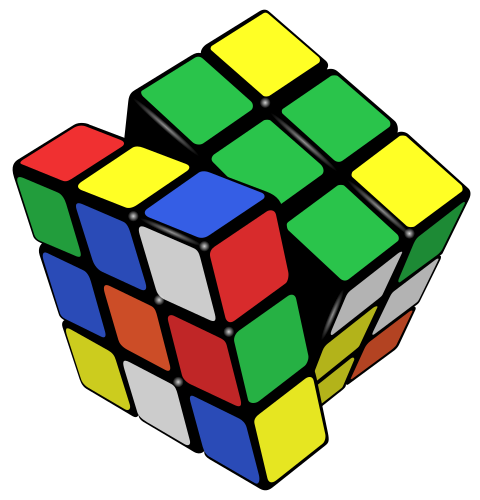
What your child gains
- Quicker reflexes with every solve
- Finger dexterity and agility
- Better hand–eye coordination
- Breaking big tasks into easy steps
- Problem-solving skills
- Optimising — finding shorter solutions
- Re-framing problems from a new angle
Course plan
Seven sessions of two hours each, following the layer-by-layer method.
-
2 hours
Session 1 · Introduction & notation
The parts of the cube — edges, corners and centres — the notation for each turn, and the layer-by-layer method we will follow.
-
2 hours
Session 2 · Bottom layer: edges
Placing the edge pieces of the first layer to form a cross.
-
2 hours
Session 3 · Bottom layer: corners
Inserting the corner pieces to complete the first layer.
-
2 hours
Session 4 · Practice: bottom layer
A full session of guided practice until the first layer is quick and reliable.
-
2 hours
Session 5 · Middle layer
Moving edge pieces into the middle layer without breaking the first.
-
2 hours
Session 6 · Middle layer practice
Solving the first two layers together, building speed and accuracy.
-
2 hours
Session 7 · Top layer
Top-layer edges, centres and corners — and the final moves to a solved cube.